 kern
kernHow to Remember Audiobooks
You finished it on your commute, loved it, recommended it twice — and today you can't reconstruct a single chapter. Audiobooks aren't worse for your brain. They're just worse at leaving evidence.
Do you really retain less from audiobooks?
The research is more forgiving than your experience suggests: when attention is equal, comprehension of spoken and written text is broadly similar — your brain processes the language either way. The honest caveat is that attention is rarely equal. Audiobooks get played while driving, cooking and half-sleeping, and divided attention weakens encoding no matter the format. Skimming back to re-read a dense paragraph — trivial on paper — also has no audio equivalent.
But the biggest difference comes after you finish, and it has nothing to do with comprehension.
The real problem: audio leaves no artifact
A print reader finishes with dog-ears, highlights, margin notes — imperfect tools, but something to return to. An audiobook finishes and evaporates. There's no highlight file, no flippable pages, nothing to trigger review. And since memory decays without retrieval regardless of format, the audiobook listener has the same forgetting curve as everyone else and fewer ways to interrupt it.
Every workaround fights the medium: pausing to take voice notes ruins the reason you chose audio (hands and eyes free); audio bookmarks pile up unreviewed; re-listening costs another ten hours for one pass of recognition-level review.
What works instead: review that doesn't need your copy
The fix is to decouple review from the format entirely. What you need after finishing an audiobook is what every reader needs: the book's core ideas as retrievable prompts, resurfacing on a schedule. None of that requires highlights, pages or the audio file.
This is exactly why Kern treats audiobooks as first-class:
- Finish your audiobook — driving, running, doing dishes, as intended. No pausing, no voice memos.
- Type the title into Kern. That's the entire capture step. The book becomes a deck of original cards: key ideas, examples, surprising claims, written in plain language.
- Swipe five minutes a day. The audiobook's cards interleave with the rest of your library, and spaced repetition brings back what's slipping — the review layer audio never had.
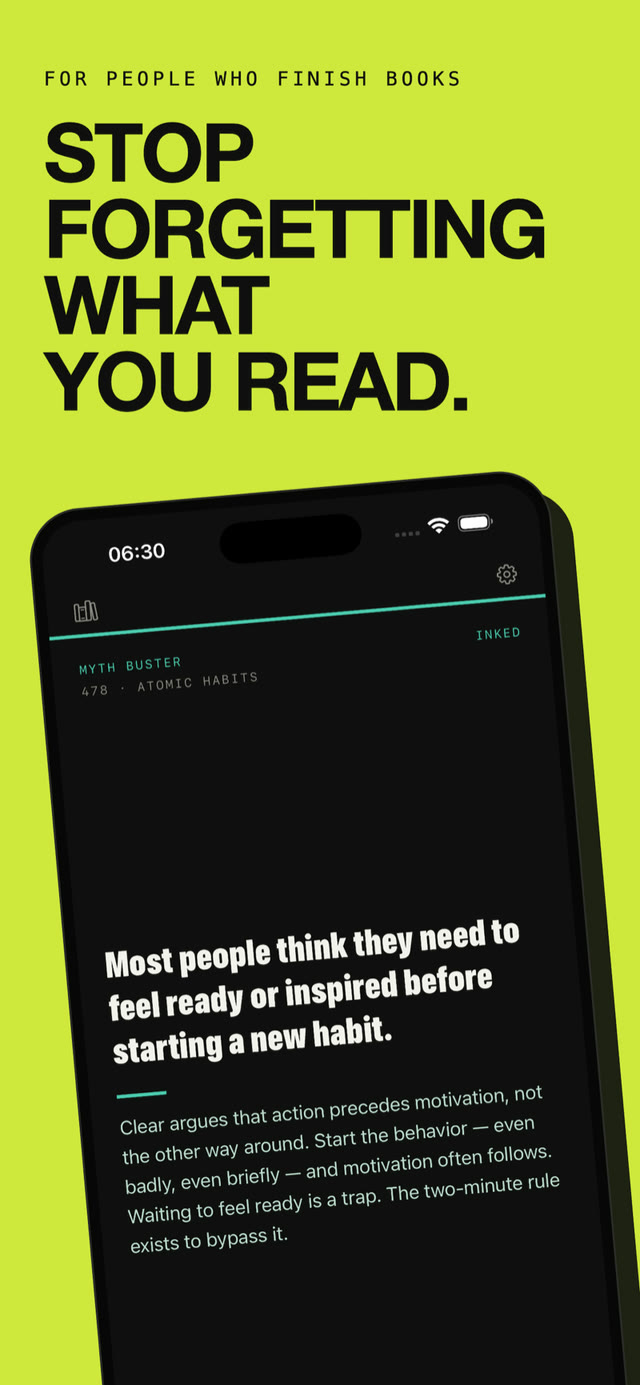
In Kern, the audiobook you heard, the paperback you read and the Kindle book from 2019 all end up in the same place: one Wall, one feed, one habit. Format stops mattering the moment you finish.
Keep what you heard
First book free. No account, no sign-up, works offline.
Download on theApp StoreFrequently asked
Should I slow the narration down to remember more?
Speed matters less than attention. At any speed, encoding happens when you're actually listening — and retention happens later, in review. A 1.5× listen followed by spaced recall beats a 1.0× listen followed by nothing.
Do I need to finish the audiobook before adding it to Kern?
Kern is built for books you've finished — the cards assume you've met the ideas once. Finish the listen, then add the title.
What about podcasts and lectures?
Kern works with published books. For a podcast episode, the old advice still applies: tell someone about it — retelling is retrieval.