 kern
kernHow to Make Flashcards From a Book
Flashcards are the most reliable way to keep a book's ideas — and the least likely thing anyone actually makes. Here are the three ways to do it, with the honest cost of each.
Option 1: Write them yourself (2–4 hours per book)
The classic route: re-skim the book, identify its 15–30 core ideas, and write each as a question-and-answer card in Anki or a notebook. Done well, this produces excellent cards — the act of writing them is itself a powerful retrieval exercise.
The catch is the cost. Card-writing is skilled, tedious work: too-literal cards don't survive out of context, too-vague cards test nothing. Between finding the ideas and phrasing them, budget 2–4 hours per book. Most readers do this exactly once, for one book, and never again. A system that dies after one book keeps one book.
Option 2: Generate from your highlights (works only sometimes)
Newer tools can turn Kindle or Readwise highlights into flashcards automatically. Better — but it inherits every limitation of highlighting:
- You need highlights. Paper books, library copies and audiobooks — for many readers, most of their library — are excluded.
- Highlights capture what felt quotable, not what mattered. Card quality is capped by your in-the-moment marking, often made before you knew where the book was going.
- Excerpts make weak cards. A sentence clipped from page 140 assumed you'd just read pages 1–139. Out of context, quotes test recognition, not understanding.
Option 3: From just the title, in seconds
This is Kern's approach. Because the goal is retention of a book you've already read, the source material doesn't need to come from your copy at all — it needs to reconstruct the book's ideas well:
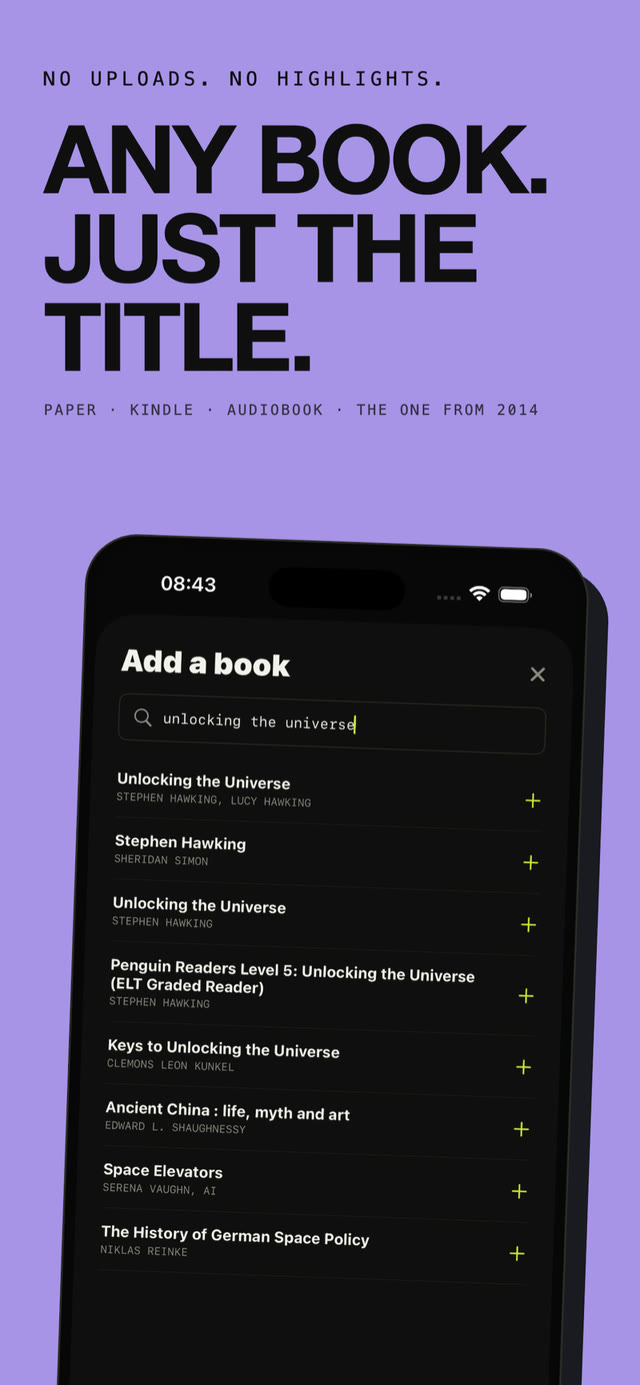
- Type the title. Search finds the book — any book you've finished, in any format, including the one from 2014. No uploads, no exports, no homework.
- Get the deck in seconds. Original cards written from the book's key ideas, examples and surprising claims, in plain language — like a smart friend telling you the best parts. Principles, myth-busters, and quick interactive checks that test what actually stuck.
- Review with everything else. New cards join the one feed shared by your whole library, and spaced repetition handles the schedule from there.
Kern's cards are paraphrased from the ideas, not excerpts: no verbatim quotes, and not a substitute for reading. If you haven't read the book, the cards will feel like spoilers without the meal. Read first; Kern keeps it.
Deck in seconds, not weekends
First book free. No account, no sign-up, works offline.
Download on theApp StoreFrequently asked
How many flashcards does one book become?
Enough to cover the key ideas, examples and surprising claims without padding — quality over volume. The deck is sized so a book stays reviewable inside a five-minute daily habit alongside the rest of your library.
Are AI-generated flashcards accurate?
Kern's cards are written from the book's ideas and arguments, the same material a careful reader would card up. Since you've read the book, you're the judge — and a card that makes you go "wait, was that right?" has already done its job: that's retrieval.
Can I make flashcards from a textbook or technical book?
Kern is built for non-fiction ideas rather than problem sets or formulas. For exam-style material with derivations, a manual Anki deck is still the right tool — see our comparison of Anki alternatives for books.