 kern
kernDo Book Summary Apps Actually Work?
Fifteen-minute versions of books you'll never read: genuinely useful, or knowledge theater? The answer depends on which problem you're solving — and most readers have a different one than they think.
What summary apps are actually for
Apps like Blinkist and Headway compress non-fiction books into 15-minute reads or listens. Used honestly, that solves a real problem: triage. There are more worthwhile books than lifetimes, and a good summary tells you whether a book deserves ten hours of yours. It can also give you conversational familiarity with books you'll consciously never read — a legitimate choice.
Where the pitch overreaches is the implied promise that consuming the summary means having the knowledge. Two problems get in the way.
Problem 1: A summary isn't the book
What makes ideas stick during real reading is the material summaries cut: worked examples, stories, failed counter-arguments, the slow accumulation of context. "Systems beat goals" as a bullet point is a fortune cookie. The same idea after forty pages of cases is a tool you can use. Compression removes exactly the redundancy your memory hooks onto.
Problem 2: Summaries obey the forgetting curve too
Even a perfect summary is still a single passive exposure — and single exposures decay on the same forgetting curve as everything else. Read fifteen summaries this month and next month you'll remember roughly what you'd remember of fifteen skimmed introductions: titles and vibes. Consumption, in any format, was never the mechanism of retention. Retrieval is.
The problem most readers actually have
Here's the quiet irony: the people downloading summary apps are usually people who already read. Their real frustration isn't "I can't get through books" — it's "I read the book, loved it, and six months later it's gone." That's not a compression problem. It's a retention problem, and a summary of a book you've already read adds nothing but déjà vu.
Summary apps vs. Kern, side by side
- The problem solved: summary apps preview books you haven't read; Kern keeps the books you have read alive.
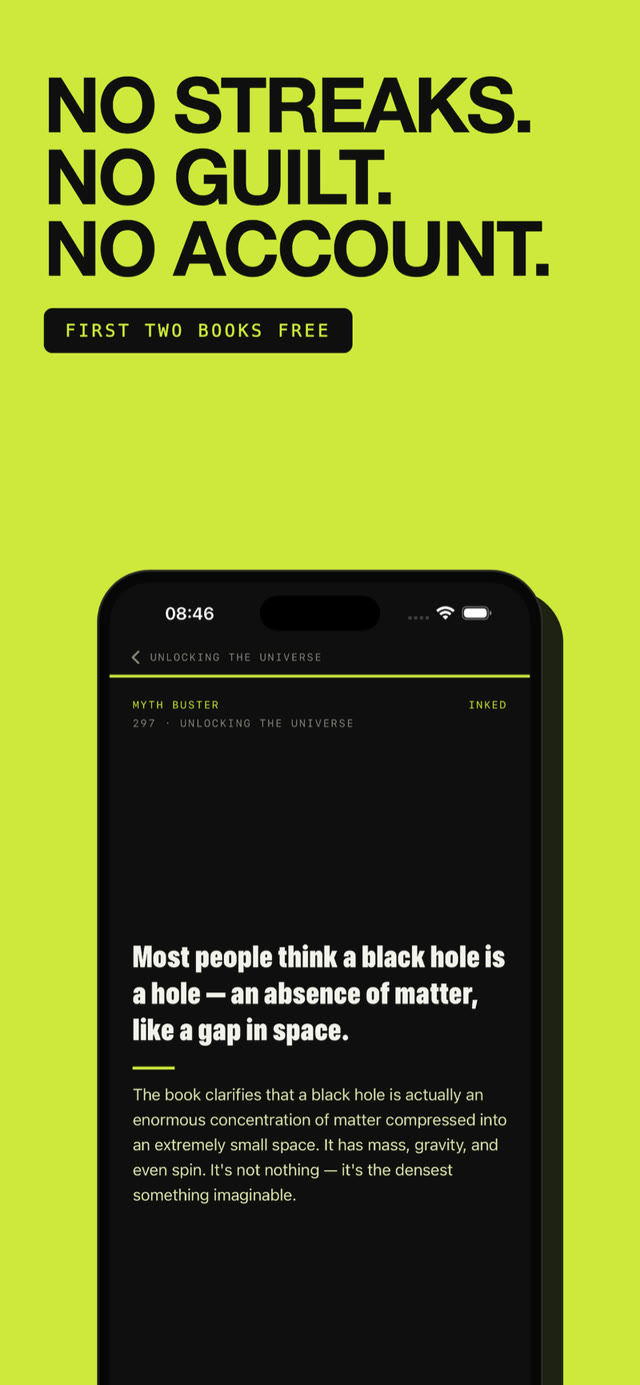
- The content: summaries replace the book in miniature. Kern's cards are recall prompts — original language, written from the key ideas, examples and surprising claims. Not excerpts, and deliberately not a substitute for reading.
- The mechanism: summaries are one more passive read. Kern is active recall on a spaced repetition schedule — the ideas come back right as they start to slip.
- The catalog: summary apps cover whatever their editors produced. Kern works from just the title, for any book you've finished — including the niche one no summary service will ever cover.
- The habit: a summary is fifteen minutes once. Kern is five minutes a day across your whole library, forever — with the Wall showing honestly which books are inked and which are fading.
Sure — they don't even compete. Use summaries to decide what's worth reading. Read the winners properly. Then add them to Kern so the ten hours you invested don't evaporate by autumn.
Reading was the investment. Keep the returns.
First book free. No account, no sign-up, works offline.
Download on theApp StoreFrequently asked
Is Kern a Blinkist alternative?
Only in the sense that both involve books and phones. If you want previews of books you haven't read, Blinkist or Headway is the right shelf. If you want the books you've finished to stay in your head, that's Kern — and it works for books no catalog carries.
Can I use Kern instead of reading the book?
You'll be disappointed — deliberately. Cards are recall prompts for ideas you've already met, not a course. They assume the encoding happened when you read; Kern's job is stopping the decay.