 kern
kernHow to Remember What You Read Without Taking Notes
You spent ten hours with that book. A month later you can name the title, the color of the cover, and maybe three ideas. Here's why that happens — and the system that fixes it in five minutes a day.
Why you forget almost everything you read
Reading a book puts information into your head exactly once. Memory doesn't work on single exposures: without retrieval, new information decays on a steep curve — most of it gone within days, the rest fading over weeks. Psychologists have measured this since Hermann Ebbinghaus first plotted the forgetting curve in 1885, and the shape hasn't changed since.
The uncomfortable part: understanding a book and remembering a book are two different cognitive operations. While you're reading, everything feels clear and obvious — that's comprehension. But comprehension leaves almost no trace by itself. What builds durable memory is retrieval: pulling the idea back out of your head after time has passed.
Why the popular methods don't work
Highlighting
Highlighting feels productive because it's effortless — which is exactly why it fails. Marking a passage doesn't require you to process it, and in study after study highlighting ranks among the least effective learning techniques. Worse, most highlights are never looked at again.
Re-reading
Re-reading creates the fluency illusion: the text feels familiar, so your brain concludes it's known. But recognizing a sentence when it's in front of you is not the same as recalling the idea when it isn't. Recognition is cheap. Recall is what you actually want.
Taking notes you never revisit
Writing summaries and book notes is genuinely better — it forces processing. But notes stored in a notebook or app you never reopen are just highlights with extra steps. The bottleneck was never capture. It's review.
What actually works: recall, spaced
Two findings in learning science are boring, unglamorous, and overwhelmingly well-replicated:
- The testing effect. Trying to retrieve an idea from memory strengthens it far more than re-exposure. Even failing and then seeing the answer beats re-reading.
- Spacing. Retrieval works best just as you're about to forget. Reviewing at growing intervals — days, then weeks, then months — moves ideas into long-term memory with remarkably little total effort.
Combine them and you get spaced repetition: the system behind Anki, medical school studying, and every serious language-learning app. It works just as well for the ideas in books. Almost nobody uses it for books, for one reason: someone has to make the cards.
The manual system (honest version)
If you want to do this by hand, here's the system:
- After finishing a book, write down its 15–30 key ideas as questions and answers, in your own words.
- Put them in a spaced repetition app like Anki, or one of its book-friendly alternatives.
- Review daily; the algorithm handles the schedule.
This works. It's also 2–4 hours of card-writing per book, and it only covers books where you still have access to the content. Most people do it for one book, feel virtuous, and never do it again. A retention system you abandon after one book retains one book.
The five-minute version
This is the problem Kern exists to solve. Instead of writing cards yourself:
- Add a book you've read — just the title. No uploads, no highlights, no homework. Works for paper books, library copies, Kindle, audiobooks, and the one you read in 2014.
- Get its ideas as cards, ready in seconds. Original cards written from the book's key ideas, examples and surprising claims — like a smart friend telling you the best parts, not excerpts.
- Swipe for five minutes a day. Cards from all your books interleave in one feed, and spaced repetition brings back the ones you're forgetting, right as they start to slip.
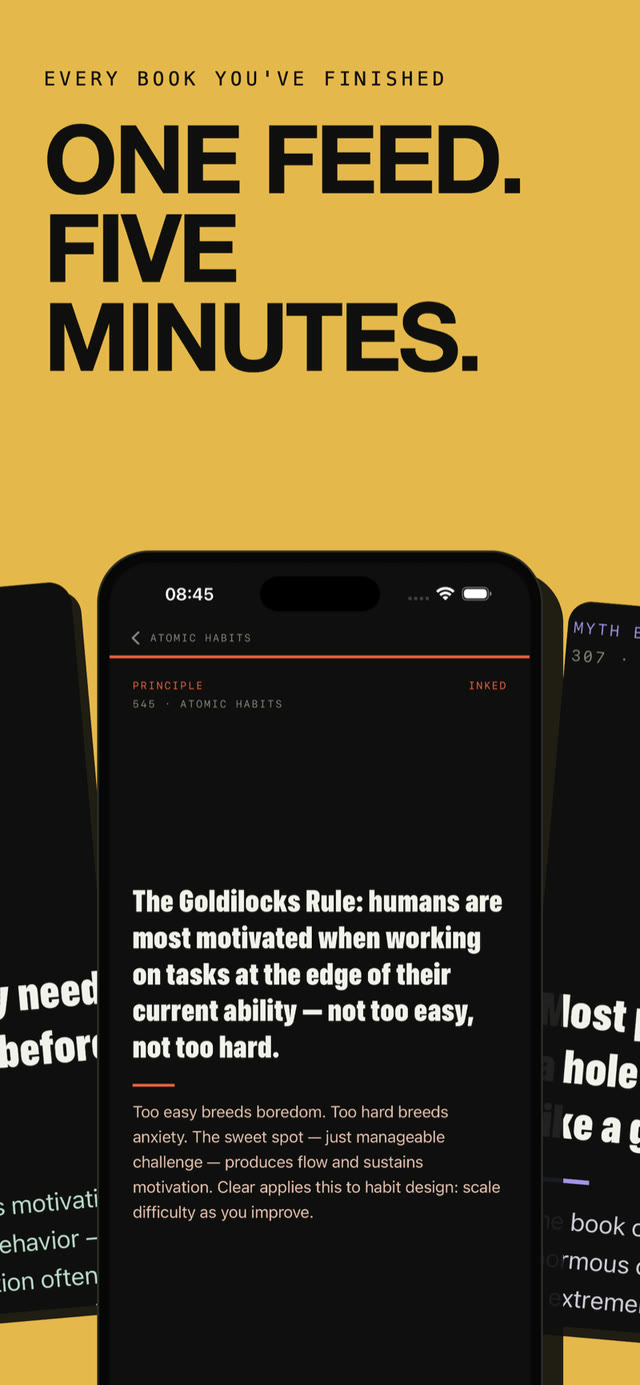
Kern also shows you the honest state of your library: every book lives on the Wall, staying inked while you review it and visibly fading when you don't. No streaks, no guilt — just an accurate picture of what's still in your head.
Stop forgetting what you read
First book free. No account, no sign-up, works offline.
Download on theApp StoreFrequently asked
How long does it take to remember a book permanently?
There's no "permanent," only maintained. With spaced repetition the maintenance cost falls fast: after a few months, a book might need one or two reviews a month to stay sharp. That's the trade — minutes per month instead of losing it entirely.
Should I still take notes while reading?
If you enjoy it, yes — processing ideas in your own words helps encoding. But don't confuse capture with retention. Whatever you capture still needs scheduled retrieval to survive.
Does this work for fiction?
The system is built for non-fiction, where the payoff is keeping ideas, frameworks and arguments usable. Fiction lives in your head differently.