 kern
Readwise Alternatives
Readwise is the best highlight tool there is. People leave it for two different reasons: the price, or the realisation that a library of highlights is not the same as remembering the books. Each reason has a different answer.
We make one of the apps on this page. Kern does not read highlights at all, which makes it an odd thing to compare with Readwise and a useful one. Readwise needs highlights. Kern needs a title. Most of what follows comes back to that difference.
What Readwise actually does
About $9.99 a month billed annually for the Full plan, $12.99 month to month, or $5.59 a month for Lite. Thirty-day free trial, no permanent free tier. Students get half off.
It pulls highlights from Kindle, Apple Books, Kobo, Instapaper and a long list of other sources into one searchable library. Each day it resurfaces a handful, spaced so older ones come back less often. You can photograph a page of a paper book to capture a passage. Full adds export to Obsidian and Notion, plus Reader, a read-later app for articles, PDFs and newsletters.
That is three jobs in one subscription: capturing what you mark, resurfacing it, and reading new things. The alternatives split along the same lines.
Save what you marked
Pull highlights out of Kindle and the web into one place.
Read articles later
A clean inbox for articles, PDFs and newsletters.
Remember the book
Be asked about what you read, before it fades.
Readwise's daily review sits between one and three: it shows you highlights again, but it does not ask you anything.
If it is the price: capture for less
Glasp
Free, with a Pro tier around $15 a month or $150 a year. A browser highlighter for the web that also exports your Kindle highlights to text, CSV or Markdown, and connects to Obsidian. The core export is free.
Glasp is built around a social layer, where you can follow other readers' highlights. If you only want your Kindle highlights out of Amazon and into files you own, it does that for nothing. There is no daily resurfacing, so the highlights land somewhere and stay there.
Obsidian with the Kindle Highlights plugin
Free. Obsidian is a notes app that stores everything as Markdown files on your device, and the community Kindle Highlights plugin syncs your highlights in using your Amazon login or the My Clippings file from the device.
This is the do-it-yourself version: one note per book, fully yours, searchable, linkable to everything else you write. If you already live in Obsidian it is the obvious move. It is Kindle only, and nothing ever comes back to you unless you go looking.
If you mainly use Reader
Matter and Instapaper
A good share of Readwise Full subscribers are really paying for Reader. If that is you, a read-later app on its own may cost less. Matter is polished and Apple-only. Instapaper has been around for well over a decade and has a limited free tier. Both let you highlight as you read, and both can feed those highlights into Readwise later if you change your mind.
If highlights were never the point
This is the reason people mention less, and the one that matters more. You have hundreds of highlights. They resurface each morning. You recognise them, nod, and could not tell anyone what the book argued.
Habits change more easily when you change the surroundings that trigger them than when you rely on willpower.
You read it, it feels familiar, you move on. That is recognition.
According to the book, what is a more reliable way to change a habit than relying on willpower?
You have to produce the answer before you see it. That is recall, and it is what sticks.
Illustrative example, written for this page.
Recognising something feels like knowing it, but recall is the real test. The research on this, usually called the testing effect, is about as settled as learning science gets: being asked and having to answer does far more for memory than seeing the material again. More on the mechanism in spaced repetition for books.
Readwise knows this. It has a feature that turns a highlight into a question or a fill-in-the-blank prompt. It works, and few people use it, because writing a good question for every highlight is the same chore that makes people quit Anki.
The second limit is coverage. Readwise only knows about books you highlighted digitally or photographed. Look at your shelf and count how many of the books that mattered to you fall into that group.
| App | Kindle | Paper | Audiobook | Read years ago |
|---|---|---|---|---|
| Readwise | ||||
| Glasp | ||||
| Obsidian plugin | ||||
| Anki | ||||
| Kern |
Anki covers everything because you write every card yourself, which takes a couple of hours per book. Kern covers everything because it needs only the title.
Anki
Free on desktop and Android, $24.99 once on iPhone. The most rigorous spaced repetition scheduler available, and it grades you: you answer, then say how hard it was, and the schedule adjusts. If you want to keep a book properly and will put in the time, nothing beats it.
The cost is the writing. You can paste Readwise highlights into Anki, but a highlight is not a question, and turning one into a good question is real work. More on this in Anki alternatives for books.
Kern
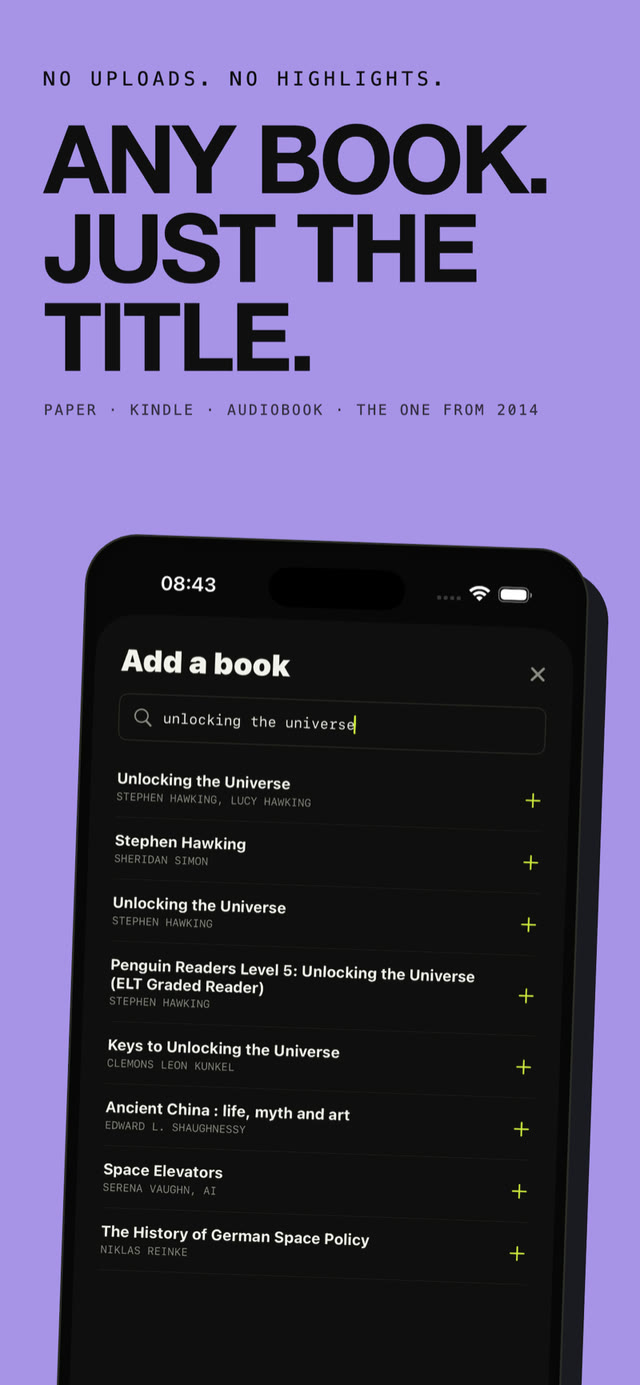
Ours, so discount accordingly. You type the title of a book you have finished, and recall cards for it exist a few seconds later. Every book you add mixes into one short daily review. No highlights, no uploads, no account. A book you read on paper in 2015 works the same as the one you finished on Kindle last week.
The cards are questions written from the book's ideas in original language. There are no quotes from the book, so if you want the exact passage you marked, Kern will not give it to you. First book free, then Kern Plus for unlimited books, or a one-off purchase to unlock a single book.
Side by side
| App | Main job | Needs from you | Asks you questions? | Price |
|---|---|---|---|---|
| Readwise | Store and resurface highlights | Highlights | Only if you write them | $5.59–9.99/mo annual |
| Glasp | Web highlights, Kindle export | Highlights | No | Free, Pro ~$150/yr |
| Obsidian plugin | Kindle highlights into notes | Highlights, setup | No | Free |
| Matter / Instapaper | Read-later | Articles | No | Free tier, paid |
| Anki | Recall anything | Cards you write | Yes | Free, $24.99 iPhone |
| Kern | Recall finished books | A title | Yes | First book free, then Plus |
Which one to pick
You love Readwise and only mind the priceTry Lite first. If you do not use Reader or the Obsidian export, Lite is most of the product for about half the price.
You want your Kindle highlights in files you ownObsidian with the Kindle Highlights plugin, or Glasp if you would rather not set anything up. Both free.
You mostly use ReaderMatter if you are all-Apple, Instapaper otherwise.
You want to remember books and will write cardsAnki. Best scheduling, lowest cost, and writing the cards is itself good practice.
You want to remember books and will not write cardsKern. Especially if the books that mattered were on paper, on audio, or read before you ever opened Readwise.
Where Kern is the wrong answer
- You want the exact words you highlighted. Kern never shows quotes from a book. Readwise is built around them.
- Articles, newsletters and the web. Kern only does books. Readwise and Reader cover everything you read online.
- You want a notes vault. Kern's cards live in the app and do not export to Obsidian or Notion.
- Android or desktop. Kern is iPhone only.
- Obscure titles. Cards come from what is known about a book, so a widely discussed bestseller gets sharper cards than a self-published title from 2011.
Keep the books you finished
First book free. No account, no sign-up, works offline.
Download on theApp StoreFrequently asked
Can I use Readwise and Kern together?
Yes, and they do not overlap. Readwise for articles and the passages you want word for word. Kern for keeping the ideas of whole books, including the ones you never highlighted.
Is there a free Readwise alternative?
For capture, yes: Glasp, or Obsidian with the Kindle Highlights plugin. Neither resurfaces highlights each day the way Readwise does. For recall, Anki is free on desktop and Android.
Readwise or Anki?
Different jobs. Readwise keeps your highlights in front of you with almost no effort. Anki makes you remember, at the cost of writing cards. Plenty of people use Readwise for everything and move the few things they truly want to keep into Anki.
Does highlighting help you remember?
Less than it feels like. Marking a passage builds familiarity, and familiarity is easy to mistake for memory. The forgetting curve calculator shows how fast an unreviewed book drains away.