 kern
kernBest Apps to Remember What You Read
Six apps get recommended for this and they do not do the same thing. Picking the wrong category is why people cycle through all of them in a year and end up exactly where they started.
There is no single best app here, and any page that crowns one is not paying attention. What there is: three distinct jobs that get lumped together under the same phrase, and a fairly clear answer once you work out which job is yours.
Three jobs, not one
Before comparing anything, sort yourself into one of these. It decides everything that follows.
- You highlight while you read and the highlights go nowhere. You want capture and resurfacing. Readwise territory.
- You want the ideas from books you have not read. That is summaries, and it is a reading substitute rather than a memory tool. Blinkist and Headway.
- You finished the book and it is draining away. You want retrieval practice on books already on your shelf. Anki, Loxie, Kern.
The third is the one most people mean and the one fewest apps actually do. It is also the only one where the forgetting curve is the thing you are fighting rather than a detail.
Job one: highlights you already make
Readwise
Around $9.99 a month billed annually, or $12.99 month to month. A Lite tier at roughly $5.59 a month drops Reader. It pulls highlights out of Kindle, Apple Books, Instapaper and the rest, keeps them in one searchable place, syncs them to Obsidian or Notion, and mails you a daily selection.
At that job it is the best thing available and has been for years. Two limits worth being clear about. It needs highlights, so it is silent on paper books, library copies, audiobooks, and every book you finished before you started using it. And reading a highlight again is recognition, not recall. You see the sentence, it feels familiar, you nod and move on. Familiarity is a weaker memory trace than having been asked a question and having had to produce the answer.
Readwise is a superb filing cabinet. Filing is not the same as remembering.
Job two: books you have not read
Blinkist
Premium runs about $99.99 a year, often discounted to around $79.99 on a first-year promo, with a Pro tier near $174.99. Fifteen-minute condensed versions of thousands of non-fiction titles.
Useful for deciding whether a book deserves ten hours, and for getting the shape of a field quickly. It is not a retention tool and does not claim to be. A summary you read once decays on exactly the same curve the book would have. If your complaint is that you forget books, a shorter thing to forget is not the fix.
Headway
Around $12.99 a month, $29.99 a quarter, or $89.99 a year. Same summary format as Blinkist with spaced repetition and streaks built in, which puts it closer to the retention side than Blinkist is.
It is a reasonable pick if you want summaries and want them to stick. It still does nothing whatsoever for the forty books already on your shelf, which is the actual complaint most people have. We went into this tradeoff at length in do book summary apps work.
Job three: books you already finished
Anki
Free on desktop and Android, $24.99 once on iPhone. The best scheduling algorithm in the category, free, with FSRS included on every platform. Nothing here beats it on rigour or long-run cost.
The cost is not money, it is that Anki schedules cards and does not write them. Turning a book into twenty properly phrased question-and-answer cards takes two to four hours of genuine editorial work, per book. Most people do it once, feel good, and never again. More detail and the alternatives in Anki alternatives for books.
Loxie
A direct competitor of ours and a fair recommendation. Free tier plus paid. Loxie keeps a catalog of popular non-fiction with questions already written for each title, delivered as a short daily drill. Same diagnosis as Kern: the cards are the bottleneck, so somebody else should write them.
The constraint is the catalog. Coverage is whatever they have built, which is solid across mainstream business and self-help and empty the moment your reading goes sideways. If your shelf is bestsellers, their decks are good and you should try them.
Kern
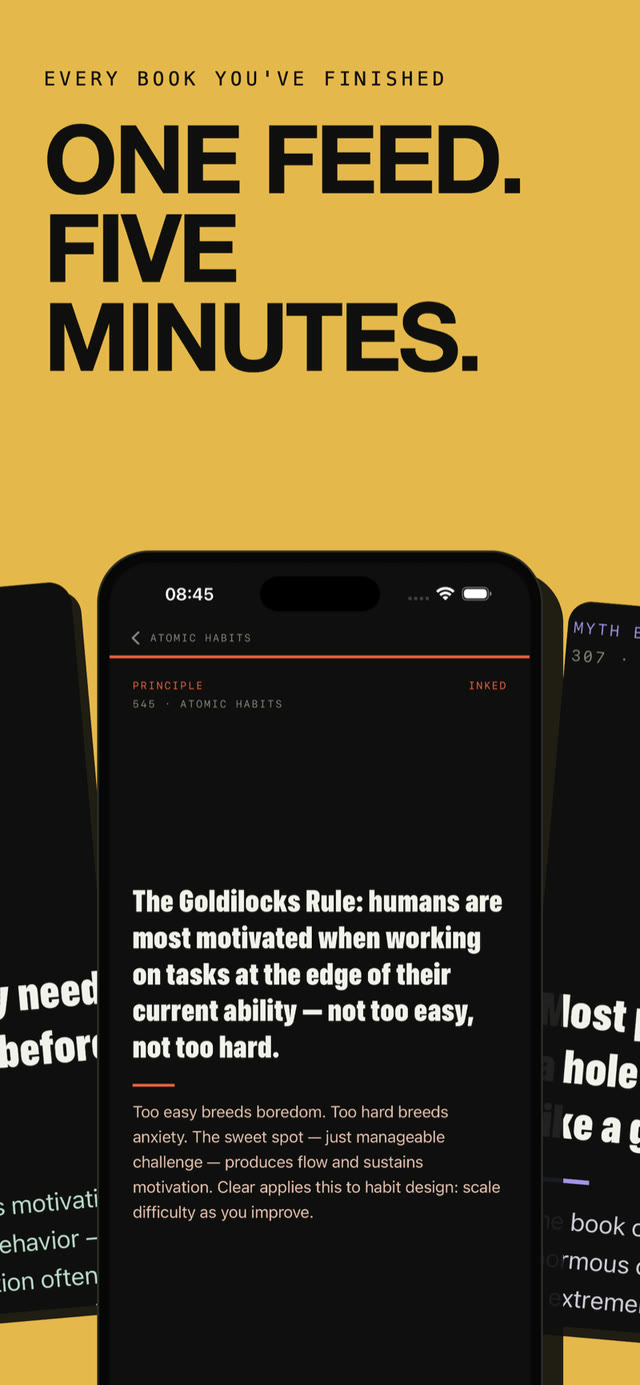
Ours, so discount accordingly. You type a title, cards for that book exist a few seconds later, and everything you have added interleaves into one review feed. Nothing to browse, because cards are generated per title rather than pulled from a fixed library, which is why a 1998 management book or something you read on paper at university works the same as a bestseller.
No highlights, no uploads, no notes, no account. First book free. After that Kern Plus unlocks unlimited books, or you can unlock one book with a one-off purchase and keep it. Cards are written from a book's ideas in original language, with no verbatim quotes.
Side by side
| App | Job it does | Needs from you | Platforms | Price |
|---|---|---|---|---|
| Readwise | Organise highlights | You to highlight | iOS, Android, web | ~$9.99/mo annual |
| Anki | Retain finished books | You to write cards | Desktop, iOS, Android, web | Free, $24.99 iPhone |
| Blinkist | Summarise unread books | Nothing | iOS, Android, web | ~$99.99/yr |
| Headway | Summarise, then review | Nothing | iOS, Android | ~$89.99/yr |
| Loxie | Retain finished books | Title, if in catalog | iOS, web | Free tier, paid |
| Kern | Retain finished books | Title only | iPhone | First book free, then Plus |
Which one, honestly
You highlight on Kindle and want it organisedReadwise, and it is not close. Just know that resurfacing highlights is a weaker memory tool than being questioned.
You will genuinely write your own cardsAnki. Best scheduling, lowest cost, and the writing itself helps you remember.
You want the gist of books you have not readHeadway over Blinkist, because at least the review layer exists. Neither touches the books you already own.
You want your finished books back and will not write cardsLoxie or Kern. Loxie if your reading sits inside their catalog, Kern if it wanders off it.
You are on Android or desktopNot Kern, which is iPhone only. Anki and AnkiDroid are free and excellent, and Readwise covers Android properly.
Where Kern is the wrong answer
A comparison written by one of the six is worth reading only if it says where its own product loses. Ours:
- No Android, no desktop, no web. iPhone only. If that is not you, nothing else on this page about Kern matters.
- You already highlight everything. You have a capture habit that works. Readwise builds on it. Kern ignores it, because it does not read highlights at all.
- Obscure titles. Cards are generated from what is known about a book, so a well-covered bestseller yields sharper cards than a self-published title from 2011.
- You want to own the file. Anki decks are yours and export cleanly. Kern's cards live in the app.
- Fiction, textbooks, anything you need word for word. Built for non-fiction ideas. Anki remains correct for exam material.
Get your finished books back
First book free. No account, no sign-up, works offline.
Download on theApp StoreFrequently asked
Can I use two of these together?
Yes, and the sensible pairing is one capture tool plus one retention tool. Readwise for articles and Kindle highlights, something retrieval-based for finished books. The pairing that wastes money is two apps doing the same job, which is usually what happens when people subscribe to Blinkist and Headway at once.
Is there a free option?
Anki, on desktop and Android, permanently. It is the only genuinely free complete answer here, and the price is your time writing cards. Loxie and Kern both have free tiers that let you test the idea before paying.
Why not just take notes?
Notes are better than highlights because writing forces you to process. But notes sitting in an app you do not reopen are highlights with extra steps. Capture was never the bottleneck. Scheduled retrieval is. More on that in spaced repetition for books.
Does any of this work for fiction?
Not really, and that is fine. These tools are built around ideas, arguments and frameworks you want to use later. Novels live in your head differently and do not need a review schedule.