 kern
Apps to Remember the Books You've Read
"Remembering books you've read" covers two different problems. Remembering which books you read is a record-keeping problem. Remembering what was in them is a memory problem. They need different apps.
Search for an app to remember the books you've read and you'll mostly find reading trackers: Goodreads, The StoryGraph and their competitors. They're good at what they do. But a lot of people asking that question already know which books they've read. Their problem is that a book they loved three years ago is down to its title and a feeling. A tracker can't fix that, because a tracker never asks you anything.
You forget which books you've read, when, and what you thought of them.
That's record keeping. A tracker solves it.
You know you read it, and you can't explain a single idea from it.
That's memory. Only being asked about the book, on a schedule, solves it.
Apps that remember which books you read
Goodreads
The default, and still the biggest catalog and community. Free, owned by Amazon, connected to Kindle, with the yearly reading challenge many people use it for. The app feels dated and the recommendations are weak, but if your friends are there, that matters more than either.
The StoryGraph
The most popular Goodreads alternative. Better stats (mood, pace and genre breakdowns) and recommendations based on what you actually like rather than what's popular. Free, with a paid Plus tier. It imports your Goodreads history, so switching is painless.
Hardcover
A newer, ad-free tracker with a clean app and a Goodreads import. Free, with an optional paid membership. A good pick if you want a tracker that feels modern and don't need the Goodreads crowd.
A notebook or a spreadsheet
It works too. Title, date, a rating and one line on why it mattered. The line is the part people skip and later wish they hadn't.
A log with your rating and a sentence of notes helps you find a book again and tells you that you liked it. It doesn't keep the contents. A four-star rating from 2021 tells you that you enjoyed a book, not what it argued. The ideas fade on the normal forgetting curve whether or not the book is on a shelf in an app.
Apps that remember what was in them
What keeps a book's contents is retrieval: being asked about its ideas, and having to answer, a few times over the weeks after you finish and then less and less often. That's spaced repetition. These apps do it in different ways, and the difference that matters is who writes the questions.
Kern
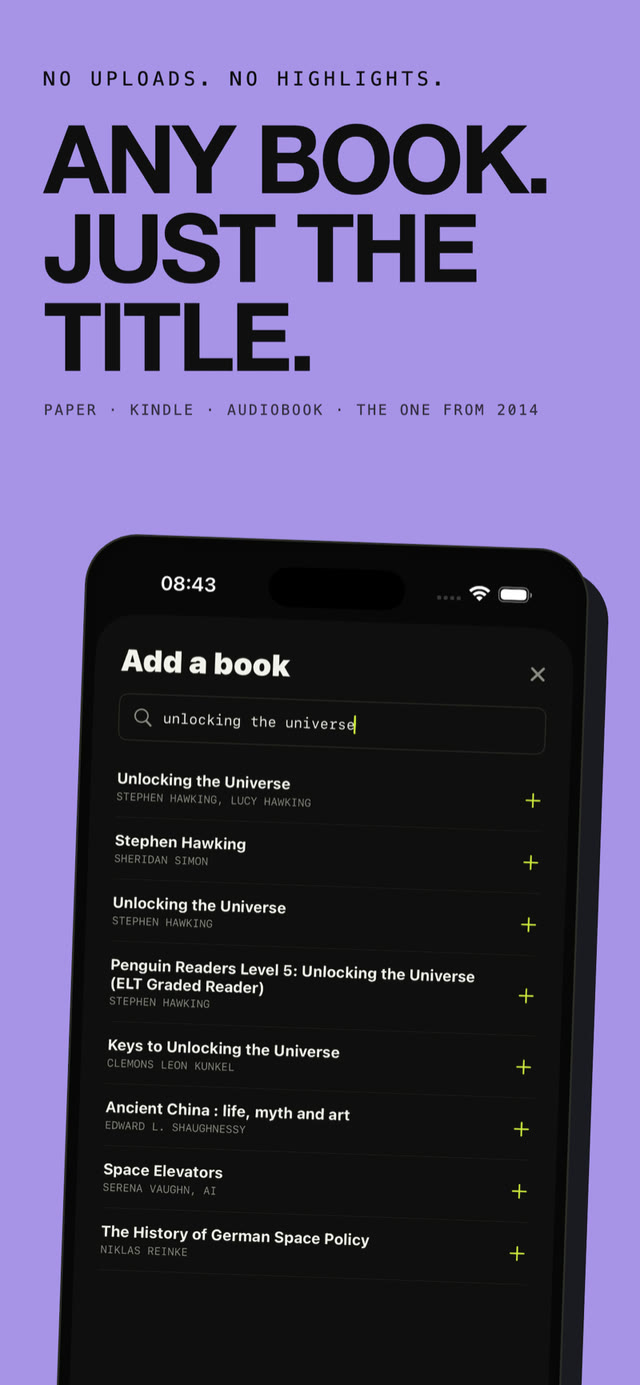
Ours, so weigh this accordingly. You type the title of a book you've finished and Kern makes a deck of cards from its ideas, or for a novel from its characters and turning points. Reviews take about five minutes a day across every book you've added. No highlights, no notes, no account. Works for paper, library books, audiobooks and books from years ago, because the title is the only input. iPhone only, first book free. The catch is that it works best on well-known books, and it will tell you if it doesn't know one well enough.
Readwise
Resurfaces the highlights you made on Kindle and other reading apps in a daily email and review. Excellent if you highlight heavily. Two limits: it only covers books you highlighted digitally (or photographed), and seeing a highlight again is recognition, which does less for memory than being asked a question. Paid, from about $5.59 a month. Compared in depth in Readwise alternatives.
Anki
The most powerful spaced repetition app there is, free on desktop and Android. You write every card yourself, which takes a couple of hours per book. Worth it if you will. Most people won't, for more than one book. A chat assistant can now draft the cards for you, covered in book flashcards with ChatGPT.
Loxie
Short daily question drills from a curated library of a few hundred books and topics, with streaks and video overviews. Questions are written by Loxie's team, so quality is consistent, but you can only drill books that are in its catalog. Compared head to head in Kern vs Loxie.
Side by side
| App | Which books | What's in them | Paper, audio |
|---|---|---|---|
| Goodreads | |||
| The StoryGraph | |||
| Hardcover | |||
| Readwise | |||
| Anki | |||
| Loxie | |||
| Kern |
Anki covers paper and audiobooks only because you write the cards yourself. Kern covers them because the title is all it needs. Kern's Wall shows every book you've added and how fresh each one is, but it isn't meant to replace a full reading log.
Use one of each, without doubling the work
Trackers and recall apps don't compete, and the combination is simple if you don't try to put everything in both:
- Log everything in the tracker. Every book, as you finish it. It's quick and it's your complete record.
- Put only the books that matter in the recall app. Not every book deserves five minutes of your attention for the next year. The ones that changed how you work or think do.
- Start from your back catalog. Open your "Read" shelf, sort by your own rating, and pick the five books you'd most hate to lose. Those go in first, even if you read them years ago. Older books come back faster than you'd expect, covered in how to remember a book you read years ago.
Which one to pick
You lose track of what you've readA tracker. Goodreads if your friends are there, The StoryGraph for better stats and recommendations, Hardcover for a cleaner app.
You remember the titles but not the ideasA recall app. Kern if you want cards made from the title, Anki if you'll write your own, Readwise if you highlight a lot on Kindle.
BothOne of each. Log everything, and keep only your best books in the recall app.
Keep what was in it
First book free. No account, no sign-up, works offline.
Download on theApp StoreFrequently asked
What is the best app to remember books you've read?
It depends on what you're forgetting. To remember which books you've read, use a tracker such as Goodreads, The StoryGraph or Hardcover. To remember what was in them, use a recall app that asks you questions on a spaced schedule, such as Kern, Anki, Readwise or Loxie. Plenty of readers use one of each.
Does Goodreads help you remember what a book was about?
Only as far as your own rating and review do. Goodreads keeps a record that you read a book, and the blurb and other readers' reviews can jog your memory, but it never asks you to recall anything, so the contents fade at the usual rate.
How do I remember what a book was about years later?
Retrieval, spaced out. Being asked about a book's ideas a few times over the weeks after you finish, then less and less often, keeps them within reach for years. Re-reading a summary or your highlights feels similar but does much less, because recognising something is easier than recalling it.
Can Kern import my Goodreads library?
No. You add books to Kern by searching for the title, which takes a few seconds per book. Most people add the handful of books they'd most hate to forget rather than their whole reading history.