 kern
How to Make Book Flashcards With ChatGPT
ChatGPT can write a decent deck for a well-known book in under a minute. That fixes the part that used to take hours. The part that decides whether you remember anything is what you do with the deck afterwards.
Writing flashcards for a book by hand takes two to four hours, which is why most people make one deck and stop. A chat assistant can now do a first draft in seconds, and for popular non-fiction the draft is good. ChatGPT, Claude and Gemini all work for this. The steps below are the same whichever you use.
There are four steps: prompt, check, import and review. Most guides stop after the first one, but the other three decide whether this works.
Use the prompt below, read the cards once and delete anything you don't recognise, import them into a spaced repetition app (Anki is free), then review for five minutes a day. Or use an app that does all four steps from just the title.
Step 1: Use a prompt built for books
Asking for "flashcards on Atomic Habits" gets you twenty vague cards that test whether you recognise a phrase. Good book cards follow a few rules. Each card holds one idea. The question makes you produce the idea instead of recognising it. The answer is short enough to check in a glance, and it's paraphrased rather than quoted. The prompt below asks for all of that, plus one thing that matters a lot: permission to say "I don't know this book".
The last two rules are for Step 3. One card per line with a | between question and answer is a format Anki can import directly.
Step 2: Check the cards before you trust them
A chat assistant writes book cards from what it learned about the book in training, not from the text. For famous books that's plenty. As the book gets less well known, three kinds of error creep in:
- Borrowed ideas. A point from a similar book gets attributed to yours. Self-help and productivity books overlap a lot, so this happens often.
- Invented examples. A plausible study or anecdote that the book never mentions.
- False precision. Confident claims about which chapter says what. Treat those with suspicion.
The fix takes five minutes. Read the deck once. If a card describes something you don't recognise at all, either you've forgotten it or the model invented it. Look it up in the book or delete it. A deck of 20 cards you trust is worth more than 25 with three inventions in it.
Step 3: Put the cards somewhere that schedules them
This is the step that's easy to skip. A chat conversation is a good place to make cards and a bad place to keep them. Memory doesn't improve because you saw a card once. It improves because the card comes back on day 2, day 6, day 20 and day 60, and comes back sooner when you get it wrong. A conversation won't do that, and neither will a note you pasted the cards into.
You need a spaced repetition app. The free, standard choice is Anki:
- Paste the cards into a plain text file and save it, for example
atomic-habits.txt. - In Anki, choose File, then Import, and pick the file.
- Set the field separator to Pipe, choose the Basic note type and a deck, then import.
Anki is free on desktop and Android and $24.99 once on iPhone. Mochi and RemNote can both import Anki decks, so starting in Anki doesn't lock you in. More on choosing between them in Anki alternatives for books.
Step 4: Review a little, often
Five minutes a day beats an hour on Sunday. Answer each card in your head before revealing it, and be honest about misses, since a miss is what tells the scheduler to bring the card back sooner. Put every book in one deck, or study them together, so the reviews mix books. Switching between books makes recall harder in a useful way, and it means one daily session covers your whole shelf. More on why in spaced repetition for books.
What about asking ChatGPT to quiz you?
ChatGPT, Claude and Gemini all have study or learning modes that will quiz you in a conversation, and that's a useful one-off. It's a good way to test yourself right after you finish a book. What it doesn't give you is the schedule: nothing brings question 14 back in eleven days because you fumbled it last week. A few third-party add-ons bolt a review schedule onto ChatGPT, which is worth a look if you want to stay inside one app.
NotebookLM is the other tool people ask about. It makes flashcards and quizzes from documents you upload, and it cites them, so its cards are grounded in the actual text. That's ideal if you have the book as a file or a stack of notes. It doesn't help with a paper book you returned to the library, an audiobook, or something you read in 2019.
Where this routine breaks down
It works. Most people still stop doing it, for reasons that have nothing to do with card quality:
- Every book is a small project. Prompt, check, save, import. That's fine once. Eleven times a year, the import is usually where it stops.
- Plain question and answer only. You can ask for cloze or multiple-choice cards, but you'll need matching note types in Anki, and most people don't bother setting them up.
- The deck lives on a laptop. Anki's desktop app is where importing is easiest, but reviews happen on a phone in spare minutes, so sync becomes one more thing to set up.
Where Kern fits
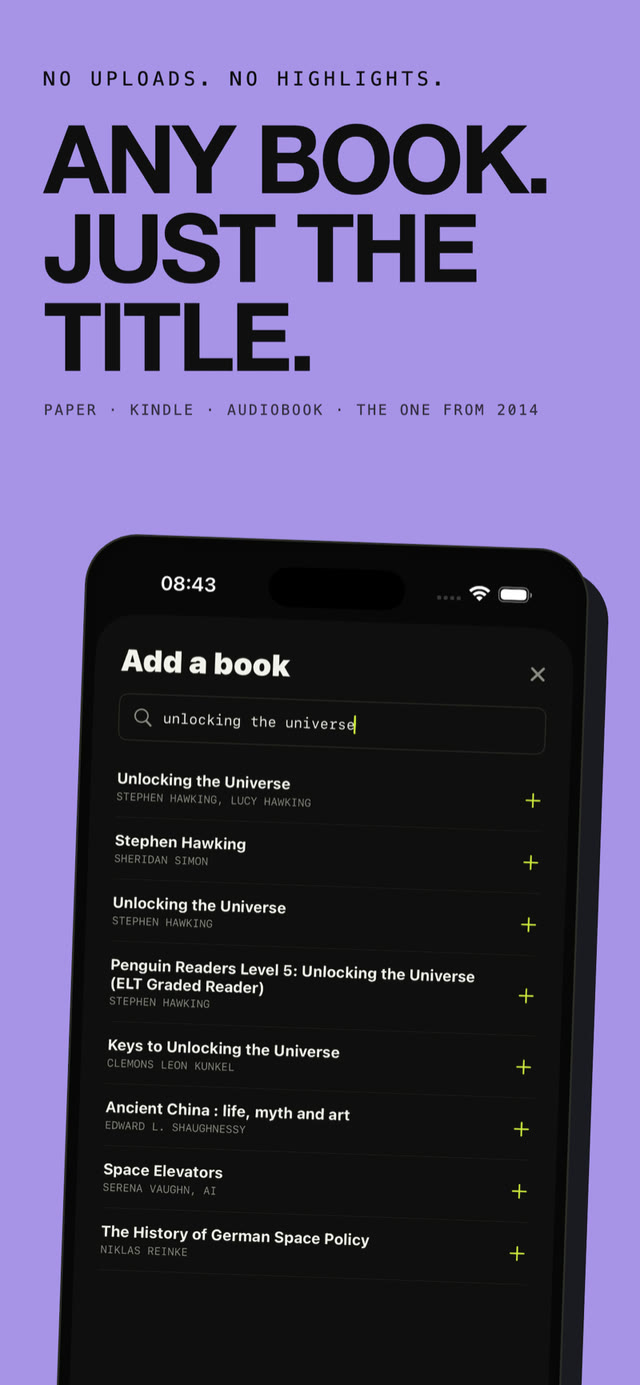
Kern is this whole routine in one app, which makes it the obvious thing for me to mention here. You type the title of a book you've finished. Kern writes 20 to 70 cards with prompts tuned for books: paraphrased, one idea each, with interactive cards mixed in, such as spotting the claim the book didn't make. All your books share one daily feed, and the schedule runs on its own. If Kern doesn't know a book well enough to write accurate cards, it says so instead of guessing.
It has the same underlying limit as ChatGPT, though. The cards come from what's widely known about a book, so famous books get the best decks. The real differences are fewer steps and the review loop. Cost is a difference too: ChatGPT plus Anki is free, and Kern is free for the first book only.
Side by side
| ChatGPT + Anki | NotebookLM | Kern | |
|---|---|---|---|
| Input | Title and a prompt | Your files and notes | Title |
| Paper books and audiobooks | Yes | Only with notes or text | Yes |
| Grounded in the text | No, model knowledge | Yes, with citations | No, model knowledge |
| Review schedule | Anki's, excellent | No long-term schedule | Built in |
| Steps per book | Prompt, check, import | Upload, generate | Type the title |
| Cost | Free (Anki iPhone $24.99) | Free tier | First book free, then paid |
Which route to take
You want it free and don't mind a few stepsChatGPT, Claude or Gemini with the prompt above, then Anki. It's a strong setup if you keep it up.
You have the text or detailed notesNotebookLM to make the cards from your sources, then a scheduler for the long run.
You want the cards and the schedule without the setupKern, if you're on iPhone. Try it on one book first, it's free.
Skip the prompt and the import
First book free. No account, no sign-up, works offline.
Download on theApp StoreFrequently asked
Can ChatGPT make flashcards from a book?
Yes, for books it knows well. Give it the title and author, ask for one idea per card with short paraphrased answers, and tell it to say so if it doesn't know the book. Popular non-fiction comes out well. Obscure titles are where it starts inventing, so check every card against what you remember.
How do I import ChatGPT flashcards into Anki?
Ask for each card on one line with the question and answer separated by a |. Paste the output into a plain text file, then in Anki choose File, Import, pick the file, set the field separator to Pipe, choose a deck and import.
Does ChatGPT do spaced repetition?
Not the way a flashcard app does. Chat assistants can quiz you inside a conversation, but a deck also needs bringing back days and weeks later, sooner for the cards you got wrong. For that you need a scheduler like Anki, or an app that handles cards and schedule together.
Are AI-generated book flashcards accurate?
For famous books, mostly. The common errors are ideas borrowed from a similar book, invented examples and confident detail about chapters. Accuracy drops as the book gets less well known. Reading the cards once against your own memory catches most of it.