 kern
How to Remember a Book You Read Years Ago
You read it, it mattered, and now you have the title and one vague idea. More of it is still in there than it feels like. Here's how to get it back without starting again from page one.
Everyone has these books. Someone mentions Sapiens or The Lean Startup or a novel you loved at twenty-five, and you say "great book" and then have nothing to add. It's an odd feeling: you clearly spent ten hours with it, and it seems to have left almost nothing behind.
It left more than you think. The problem is mostly getting to it.
It isn't gone. It's out of reach.
Three findings from memory research explain what's happened to that book, and why getting it back is easier than reading it the first time.
Stored is not the same as reachable. In 1966, Endel Tulving and Zena Pearlstone had people learn word lists and then recall them. Some got category names as cues ("animals", "furniture") and others didn't. The people with cues recalled far more. The words were stored in both groups, and the cues decided how many came back. Psychologists call this the difference between what's available in memory and what's accessible right now. An old book is mostly available and barely accessible.
Relearning is cheaper than learning. Hermann Ebbinghaus found this on himself in the 1880s. Lists he could no longer recall at all still took fewer repetitions to relearn than they had the first time. He called the difference "savings". Something of the first learning survives even when you can't recall any of it.
Some of it lasts a very long time. In 1984, Harry Bahrick tested people on Spanish they'd learned in school, up to fifty years earlier. They lost a lot in the first three to six years, and after that the curve stayed almost flat for around thirty years. Bahrick called what was left a "permastore". How well people had learned the material in the first place predicted how much stayed.
The ideas you can't recall are mostly still stored, just with no path back to them. The right cue reopens a path, and each idea you get back takes less effort than learning it from the page. Robert and Elizabeth Bjork's work adds one more useful twist: recalling something you'd nearly lost strengthens it more than recalling something easy. Your old books are well placed to benefit.
Step 1: Find out what's left
Take two minutes and a blank page. No looking anything up. Write down every idea, argument, example or (for a novel) character and turning point you can remember from the book. Don't judge as you go. Then count.
Almost nothing, and you're not sure you understood it back thenRe-read it, or at least the parts that matter. Nothing in this guide can bring back understanding you never built, and a second reading of a good book is rarely wasted.
A few ideas, with fuzzy edgesThe most common result. You're in the right place for cues and recall. Re-reading the whole thing would be slow, and much of it would only feel familiar.
More than you expectedGood. The book is there and you mainly need to keep it. Skip to step 4.
Step 2: Give your memory cues, not answers
The usual move is to re-read the book or a summary. It feels productive because everything looks familiar. That familiarity is the problem. Recognising an idea when you see it is much easier than producing it, so re-reading tells you very little about what you'd remember tomorrow. It's also slow.
Cues work the other way. They point at an idea without handing it over, so you have to do the recall yourself. Good cues for an old book:
- The table of contents. Turn each chapter title into a question: what was this chapter's argument? Answer it before you look further.
- Your old highlights or margin notes, if you made any. Cover the text and use the location as a prompt.
- Questions about the book. "What does the author say is wrong with setting goals?" makes you produce something. A summary sentence just lets you nod.
- Explaining it to someone. Ask a friend who's read it what they remember, and see what that sets off.
Step 3: Re-read only what didn't come back
After the cues, you'll have a clear list of ideas you got back and gaps you didn't. Now open the book, and only for the gaps. Find the chapter, read it with the question in mind, then close the book and explain the idea in two or three sentences of your own. Out loud or written, either works. That last step turns re-reading into recall.
Step 4: Space the next few encounters
A book you've just brought back is fragile. Without another look it'll slip the same way it did before, only faster. Test yourself again a few days later, then about a week after that, then a month later. Each round needs less effort than the last. That's Ebbinghaus's savings again, working in your favour. After a few rounds the book has a lasting path back.
You can do this with a notebook of questions and a calendar reminder. Or you can let a spaced repetition app keep the schedule for you. The forgetting curve calculator shows roughly what each round does to the slope.
The options, by time
| Approach | Rough time | What it does | Best when |
|---|---|---|---|
| Re-read the whole book | A weekend | Rebuilds everything, slowly | You never really understood it |
| Read a summary | 20 minutes | Recognition, fades fast | You only need the gist for a conversation |
| Cues, then targeted re-reading | An evening, then short check-ins | Recall where it counts | You remember the outline, not the details |
| Recall cards on a schedule | A few minutes a day for a few weeks | Recall and spacing together | You want the book back and kept |
Doing it with Kern
This is the job Kern was built for, so take this section as our pitch. You type the title of the old book. Kern writes cards from its ideas (or, for a novel, its characters, relationships and turning points) and starts bringing them back on a schedule. No highlights or notes needed, so it works for the paperback you gave away and the audiobook you finished in 2019.
The first session with an old book is the Tulving effect in practice. Ideas you couldn't have written on a blank page come back when a card asks about them. The ones that don't come back count as misses and return sooner. A few weeks of five-minute sessions, mixed in with your other books, and the book is back where you can use it.
It's the wrong tool in two cases. If you never understood the book in the first place, re-read it. And if the book is obscure, Kern may not know it well enough to write accurate cards, in which case it says so.
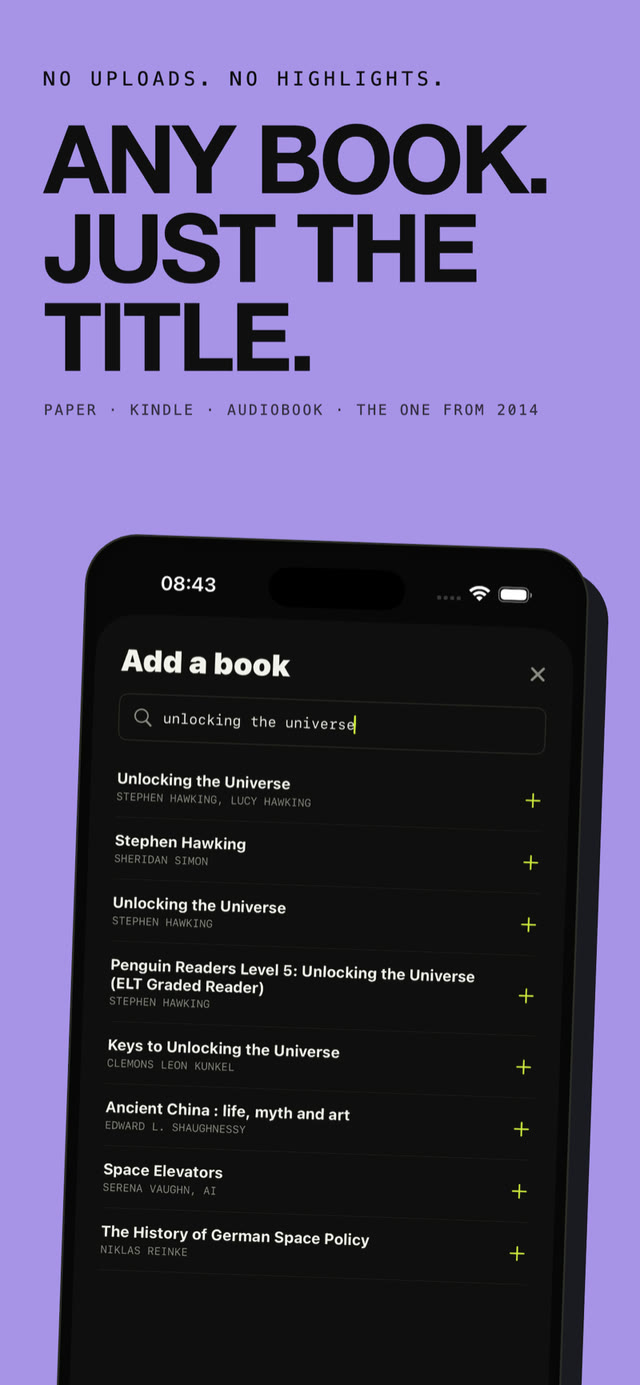
Get an old book back
First book free. No account, no sign-up, works offline.
Download on theApp StoreFrequently asked
Can you remember a book you read ten years ago?
Usually more than you think. Memory research separates whether something is stored from whether you can reach it right now, and old books mostly fail on the second. Given the right cues, such as questions about the book's ideas, a lot comes back, and relearning it is much faster than learning it the first time.
Is it worth re-reading a book to remember it?
Sometimes. Re-read if you remember almost nothing and aren't sure you understood the book the first time. If you remember the outline but not the details, re-reading cover to cover is slow and feels more productive than it is. Testing yourself with questions, then re-reading only the parts you can't recall, works better.
How long does it take to forget a book?
Most forgetting happens early. Without review, much of a book's detail is hard to recall within a month, and the decline slows after that. What survives the first few years tends to stay for a long time. More in why you forget what you read.
Should I re-read or use flashcards for an old book?
Start with flashcards or other questions, then re-read only what they show you've lost. Being asked about an idea brings back more than reading about it again, and it shows you exactly which parts need the book.